
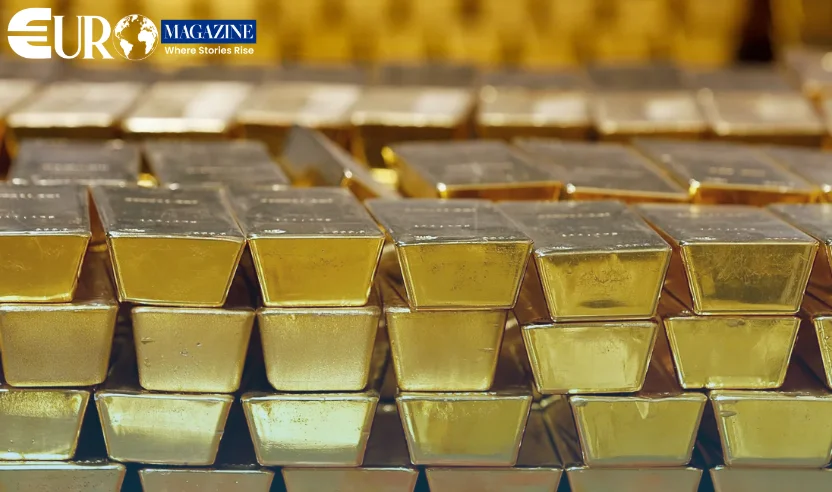
At the end of 2025, Banco de España reported gold and foreign exchange reserves valued at nearly €94 billion, the highest level since comparable records became available.
The rise was driven mainly by strong international demand for gold, which continued to be viewed as a safe-haven asset amid geopolitical tensions and financial uncertainty, despite recent market volatility.
In Spain, however, gold carries meaning beyond balance sheets. It is also deeply linked to history, particularly the long-debated episode known as “Moscow gold,” one of the most controversial chapters of the country’s 20th-century past.
Gold before the Civil War
Before 1936, Spain’s gold reserves were not exceptional by global standards, but they were sufficient to provide the country with limited room for international financial manoeuvre.
Historians note that while Spain was far from being a major economic power, its gold reserves allowed a degree of financial flexibility within the international system of the time.
Gold sent abroad during the war
That margin disappeared with the outbreak of the Spanish Civil War. Diplomatic isolation and the Non-Intervention policy left the Republican government with few options to finance military supplies.
In response, most of the Bank of Spain’s gold reserves were transferred abroad, primarily to the Soviet Union, to pay for weapons, equipment and logistical support. In October 1936, around 510 tonnes of gold were shipped from Cartagena.
Historians emphasise that the transfer was a documented and deliberate decision taken by the Republic’s authorities under wartime conditions, rather than a clandestine operation.
Debunking the ‘return the gold’ narrative
Later research has challenged long-standing claims that the gold should have been returned.
Studies show the gold was spent during the war through documented payments, allowing the Republican government to continue fighting for nearly three years. From this perspective, the transfer functioned as wartime financing rather than theft or plunder.
A smaller portion of gold was also sold to France, though that episode never gained the same symbolic significance.
A tool of post-war propaganda
After the war, the Franco regime used the “Moscow gold” narrative extensively in political messaging, portraying it as evidence of betrayal and foreign exploitation.
While the issue featured heavily in domestic discourse, it gained little traction internationally. British authorities regarded it as a bilateral matter, and Soviet officials consistently stated that no Spanish gold remained unaccounted for.
Where Spain’s gold is today
Nearly nine decades later, Spain holds around 281 tonnes of gold, according to data from the World Gold Council.
The reserves are split between holdings at the Bank of Spain and deposits in the United States, the United Kingdom and Switzerland. These assets are unrelated to the gold transferred during the Civil War and reflect decades of modern monetary policy and European integration.
From survival tool to financial asset
The record valuation reached in 2025 does not represent the recovery of lost wartime gold. Instead, it reflects rising global gold prices.
Unlike in the 1930s, gold today no longer directly finances governments or backs national currencies. It now serves as a stabilising asset that supports confidence within the global financial system.
The contrast between 1936 and 2025 highlights a fundamental shift: once a resource tied to political survival, gold has become a strategic financial instrument shaped by markets rather than conflict.