
Eurozone economic activity continued to expand at the start of 2026, but a renewed rise in services-sector inflation is raising fresh concerns for policymakers and complicating the interest-rate outlook for the European Central Bank.
Flash Purchasing Managers’ Index (PMI) data released for January by Hamburg Commercial Bank (HCOB) and S&P Global show the euro area’s private sector grew for an eighth consecutive month. However, underlying price pressures, particularly in services, appear to be strengthening, despite headline inflation falling below the ECB’s target late last year.
The eurozone composite PMI, which measures activity across manufacturing and services, held steady at 51.5 in January, slightly below market expectations of 51.8, indicating continued but modest growth.
“The recovery still looks rather feeble,” said Dr. Cyrus de la Rubia, chief economist at HCOB.
Services Inflation Raises Red Flags
While services activity remained in expansion territory, momentum softened. The eurozone services PMI slipped to 51.9, its lowest level in four months, down from 52.4 in December and below forecasts.
Manufacturing, meanwhile, remained in contraction for a third consecutive month, with output still below the 50-point threshold that separates growth from decline.
The more troubling signal for policymakers came from price data. According to the PMI report, selling-price inflation in the services sector accelerated sharply in January, reaching its highest level since April 2024.
“Inflation in the services sector, which the central bank is watching particularly closely, has increased significantly in terms of sales prices,” de la Rubia said.
By contrast, manufacturing output prices continued to edge lower, highlighting a growing divergence between the two sectors.
ECB Faces a Complicated Path
Eurozone inflation eased to 1.9% in December, dipping just below the ECB’s 2% target. However, the latest data suggest that underlying price pressures remain uneven and potentially persistent.
In its most recent projections, the ECB forecast inflation at 1.9% in 2026 and 1.8% in 2027, but some economists now warn that those assumptions could be tested if services inflation continues to rise.
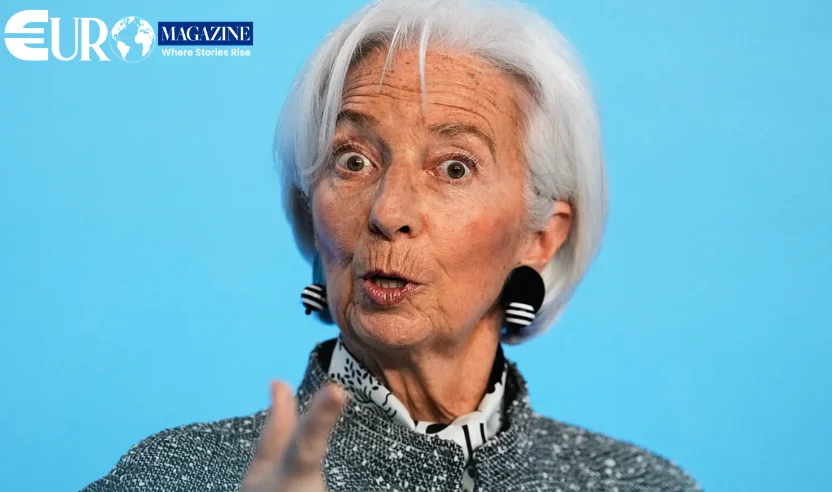
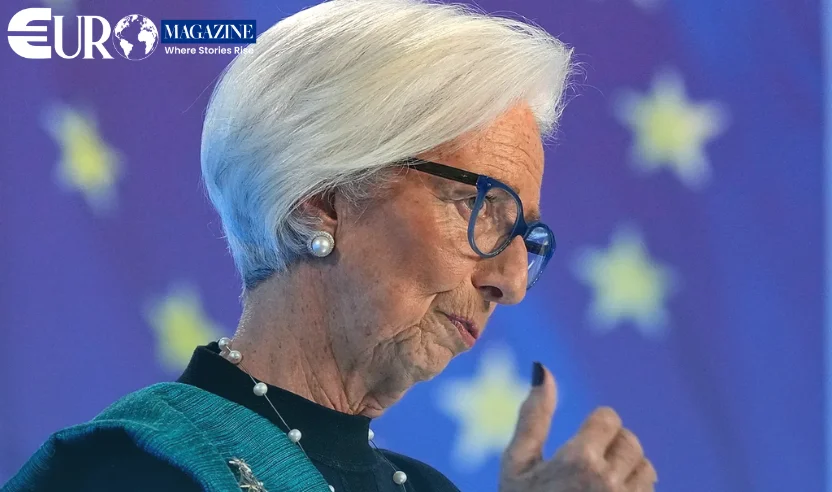
At the ECB’s December meeting, President Christine Lagarde acknowledged that elevated services inflation was “hardly surprising,” noting that it was being offset by falling goods prices as the two components moved in opposite directions.
Still, de la Rubia said the January data may strengthen the case for caution among policymakers, with some of the more hawkish members of the Governing Council potentially arguing that the next policy move should not be an interest-rate cut, and could even be a hike.
Business Confidence Improves Despite Risks
Despite inflation concerns and uneven growth, business sentiment across the eurozone improved notably in January. Overall confidence about the year ahead rose to a 20-month high, supported by stronger optimism in both services and manufacturing.
Manufacturers, in particular, reported their highest level of confidence in nearly four years, suggesting expectations of stabilisation later in 2026.
Germany and France Move in Opposite Directions
Data from the eurozone’s two largest economies point to diverging trends.
In Germany, private sector activity strengthened, with the composite PMI rising to 52.5, a three-month high and well above expectations.
“The data show a good start to the new year,” de la Rubia said, pointing to a return to modest growth in manufacturing output and new orders, alongside a more convincing pickup in services activity.
By contrast, France slipped back into contraction. France’s composite PMI fell to 48.6, down from a neutral 50 reading in December and below forecasts, marking the first contraction since October.
Economists say external pressures continue to weigh heavily on French firms, particularly exporters. Renewed tariff threats from the United States, including the possibility of steep duties on French champagne, have added to uncertainty for businesses already grappling with a strong euro and increased competition from China.
While progress on France’s 2026 national budget has provided some political stability, analysts caution that manufacturing remains under pressure, with new orders still contracting and export performance weak.
Inflation Risks Remain on the Radar
As 2026 begins, the eurozone economy appears to be growing, but only modestly. The renewed rise in services inflation suggests that the ECB’s battle with price pressures may not be fully over, even as headline inflation retreats.
Whether this proves to be a temporary blip or the start of a broader inflation comeback will be central to the ECB’s policy decisions in the months ahead.